

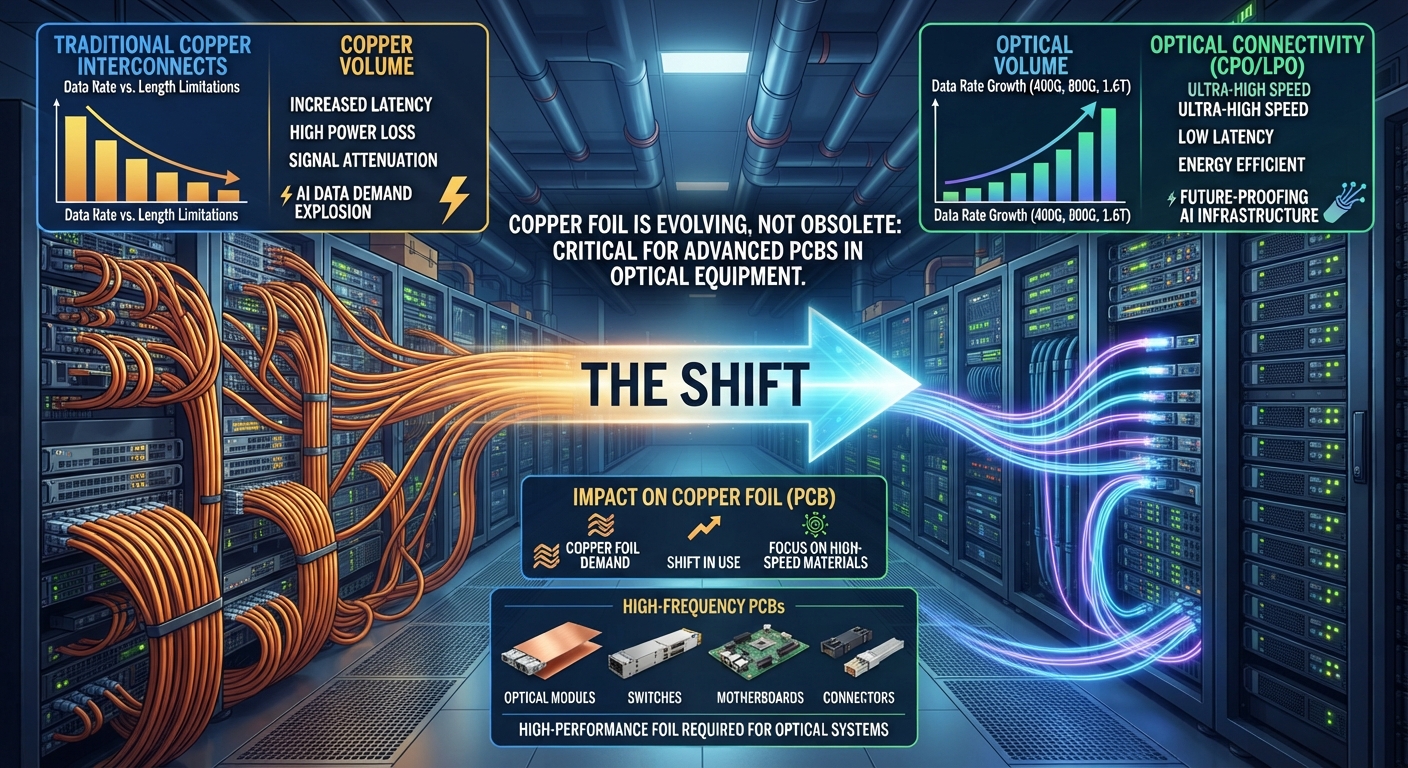
As AI infrastructure evolves, optical connectivity is becoming increasingly important. But does the rise of optical technology mean copper is losing its place in the data center industry? Not necessarily.
The rapid development of Artificial Intelligence (AI) is transforming data center infrastructure. As AI models become larger and computing workloads become more demanding, data centers need faster communication, higher bandwidth, lower latency, and greater energy efficiency.
One major technological shift is the growing adoption of optical connectivity.
Traditional electrical interconnects transmit data through copper conductors, while optical interconnects use light to carry information. Optical technology offers significant advantages in high-bandwidth, long-distance data transmission, making it an attractive solution for next-generation AI data centers.
However, this transition does not mean copper is becoming obsolete. Instead, it is changing how copper and optical technologies work together.
1. Optical Connectivity Is Changing the Data Center Landscape
As AI data centers expand, the limitations of traditional copper-based connections are becoming more apparent.
At higher transmission speeds, electrical signals traveling through copper cables and PCB traces experience greater signal loss, attenuation, and crosstalk. These challenges make it increasingly difficult to maintain signal integrity while controlling power consumption.
Optical connectivity addresses many of these challenges by transmitting data through light rather than electrical signals.
Technologies such as:
- Pluggable Optical Transceivers: Enable high-speed communication between switches and servers.
- Silicon Photonics: Integrates optical functions into semiconductor platforms.
- Co-Packaged Optics (CPO): Places optical engines closer to high-performance processors and switching chips, reducing the length of high-speed electrical connections.
These technologies are helping build faster, more energy-efficient AI infrastructure.
2. Does Optical Connectivity Mean Less Demand for Copper?
Not entirely.
Although optical technology is taking over an increasing number of high-speed, longer-distance transmission applications, copper remains essential in many parts of data center infrastructure.
The transition is not simply about replacing copper with optical fiber. It is about finding the right material and technology for different connection requirements.
Copper continues to play an important role in:
- PCB circuits and internal electrical connections.
- Server boards and high-speed circuit boards.
- Power distribution systems and electrical connections.
- Short-distance, high-speed interconnects where copper remains cost-effective.
Even in optical networking architectures, electrical signals still need to travel between processors, chips, and optical components.
This means copper-based electronic components and circuit materials will continue to be important.
3. What Does This Mean for Copper Foil?
For copper foil manufacturers, the development of AI data centers brings both challenges and opportunities.
As high-speed computing systems become more sophisticated, PCB materials must meet increasingly demanding performance requirements.
Several factors are becoming particularly important:
1. Lower Surface Roughness
High-frequency signals are sensitive to conductor surface conditions. Lower-profile copper foil can help reduce conductor-related signal losses and support high-speed signal transmission.
2. Excellent Electrical Conductivity
As data transmission speeds increase, stable electrical performance becomes increasingly important. Copper foil with consistent conductivity helps support reliable circuit performance.
3. Uniform Thickness and Surface Quality
Advanced multilayer PCBs require precise material specifications. Consistent thickness, surface quality, and manufacturing stability are essential for reliable production.
4. Strong Adhesion and Reliability
Copper foil must maintain reliable bonding with dielectric materials while meeting demanding thermal and mechanical requirements during PCB manufacturing and operation.
These requirements make high-performance rolled copper foil and advanced electrodeposited copper foil important materials to watch in the evolving electronics industry.
4. The Future: Copper and Optics Working Together
The future of AI data centers will not be defined by a single connectivity technology.
Optical communication will continue expanding into applications where bandwidth, transmission distance, and power efficiency are critical.
Meanwhile, copper will remain important wherever electrical connectivity, material reliability, cost efficiency, and integration requirements make it the practical choice.
For the copper foil industry, the key opportunity is not simply producing more material, but developing higher-performance products that meet the evolving requirements of next-generation electronics.
As AI infrastructure moves toward faster optical connectivity, the demand for advanced electronic materials will continue to evolve.
The real question is not whether copper or optics will win.
It is how both technologies will work together to power the next generation of AI infrastructure.
About CIVEN METAL
At CIVEN METAL, we specialize in high-end rolled copper foil and copper alloy materials, providing solutions for advanced electronics and industrial applications.
We continuously focus on material performance, product consistency, and the evolving needs of the global electronics industry.
CIVEN METAL Material (Shanghai) Co., Ltd.
Website: www.civen.cn
Email: sales@civen.cn
Phone: +86-21-56351345
Address: No. 1888 Xiechun Road, Jiading District, Shanghai, China, Workshop 2-2.